SHIFT
Enabling instant credit increases
Cloud data management portal
Cloud data management portal
Shift provides financing solutions that allow businesses to access working capital through credit lines. However, increasing credit limits was a manual, time-consuming process that relied heavily on the support team.
I led the design of a self-serve credit limit increase (CLI) experience, enabling businesses to request and receive additional credit directly within the platform.
This feature reduced operational friction while helping the business achieve its goal of increasing the amount of capital deployed to customers.
RESPONSIBILITIES
Creative Direction, Visual Design, Design Language, UX, Interaction Design
Problem space
If a business needed a higher credit limit, the owner had to call Shift support, get transferred to the credit team, answer a series of questions, and then wait several days to hear back.
This created friction for customers and extra work for internal teams. Business owners didn’t know how long approvals would take or what information they’d need to provide, and the support team spent a lot of time handling requests that could have been done online.
It became clear the platform needed a simple, self-serve way for businesses to request a credit limit increase without picking up the phone.
The existing experience
- Customer contacts Shift support
- Support transfers request to the credit department
- Customer answers a series of credit questions
- Documentation may be requested
- Approval can take several days
Customer pain points:
- Slow and inconvenient
- Lack of transparency on application status
- Multiple touchpoints required
Business pain points:
- Support team overloaded with manual requests
- Credit team processing applications inefficiently
- Friction preventing customers from accessing additional credit
This created a bottleneck in credit growth, directly limiting the amount of funds Shift could deploy.
Business goals
Design a self-serve credit limit increase feature that:
- Eliminates the need to call support
- Provides a clear and transparent application process
- Enables instant approvals where possible
- Maintains compliance with credit and risk policies
- Ultimately increases the amount of capital deployed
Discovery and research
To understand how automation could work safely, I collaborated closely with the credit and risk teams.
Key questions
- What data is required to approve a credit increase?
- Which criteria could enable instant approval?
- Which cases require manual review?
- What regulatory or compliance requirements must be respected?
Many businesses could be pre-approved based on:
- Existing repayment history
- Credit risk rating
- Security already held by Shift
- Current utilisation and financial profile
This meant we could automate approvals for a large percentage of requests.
Surfacing key pain points
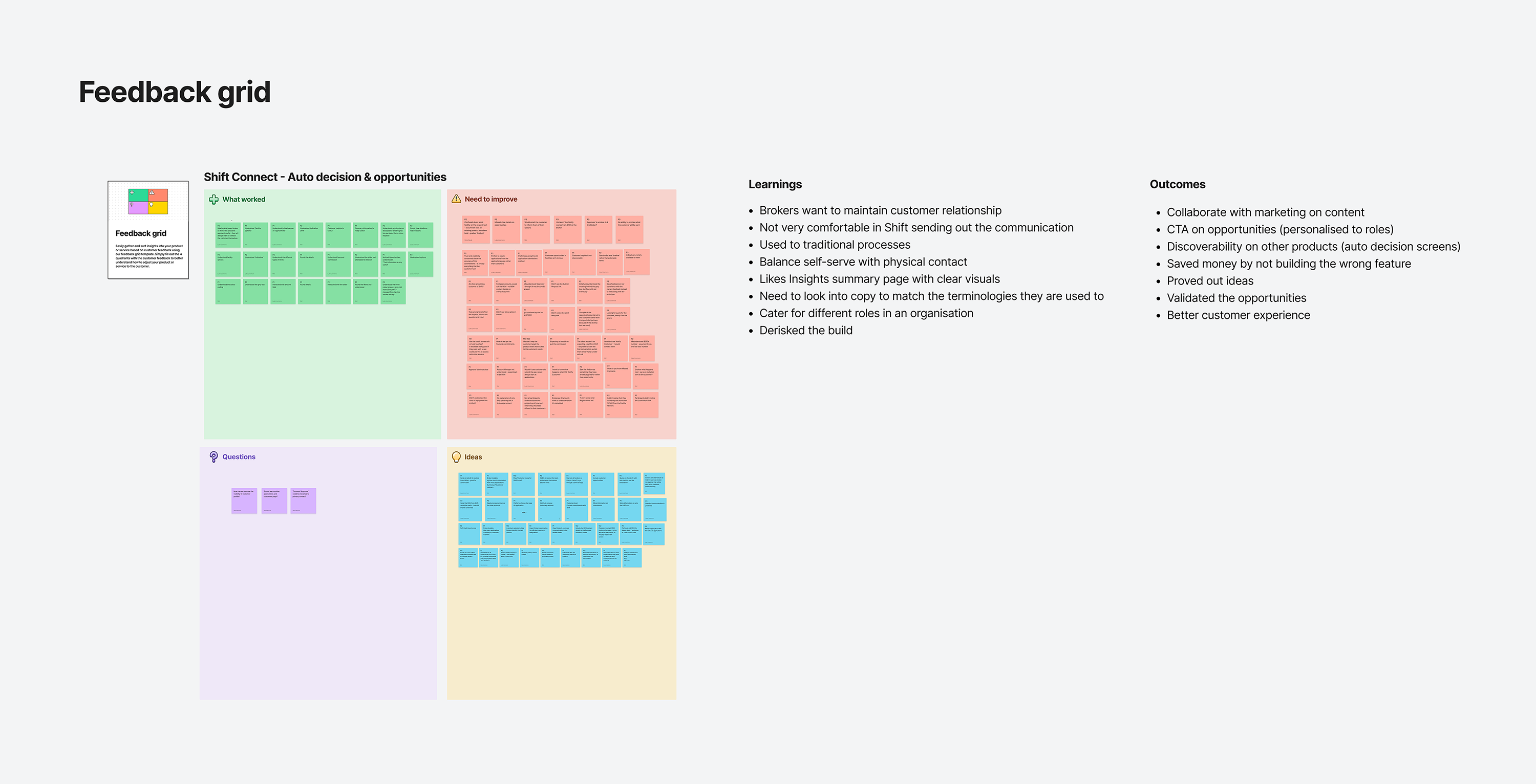
Through a series of workshops with the credit, risk, and support teams, we unpacked how credit limit increases were currently handled and where the biggest friction points were.
The discussions highlighted that the problem wasn’t just the lack of a self-serve feature, it was the complexity of the credit decision process behind the scenes. Credit increases depended on factors like repayment history, risk ratings, existing security, and the size of the requested increase.
At the same time, support and credit teams were spending a lot of time handling calls for requests that were often straightforward.
The workshops helped the team identify two important things:
- Many businesses could safely receive instant credit increases based on existing data.
- More complex requests would still require manual review by the credit team.
- Mapping the current process alongside real customer scenarios made it clear that the opportunity wasn’t just to digitise the phone workflow. Instead, we could separate instant approvals from manual reviews, allowing the platform to handle simple requests automatically while still supporting the credit team’s risk controls.
Journey mapping
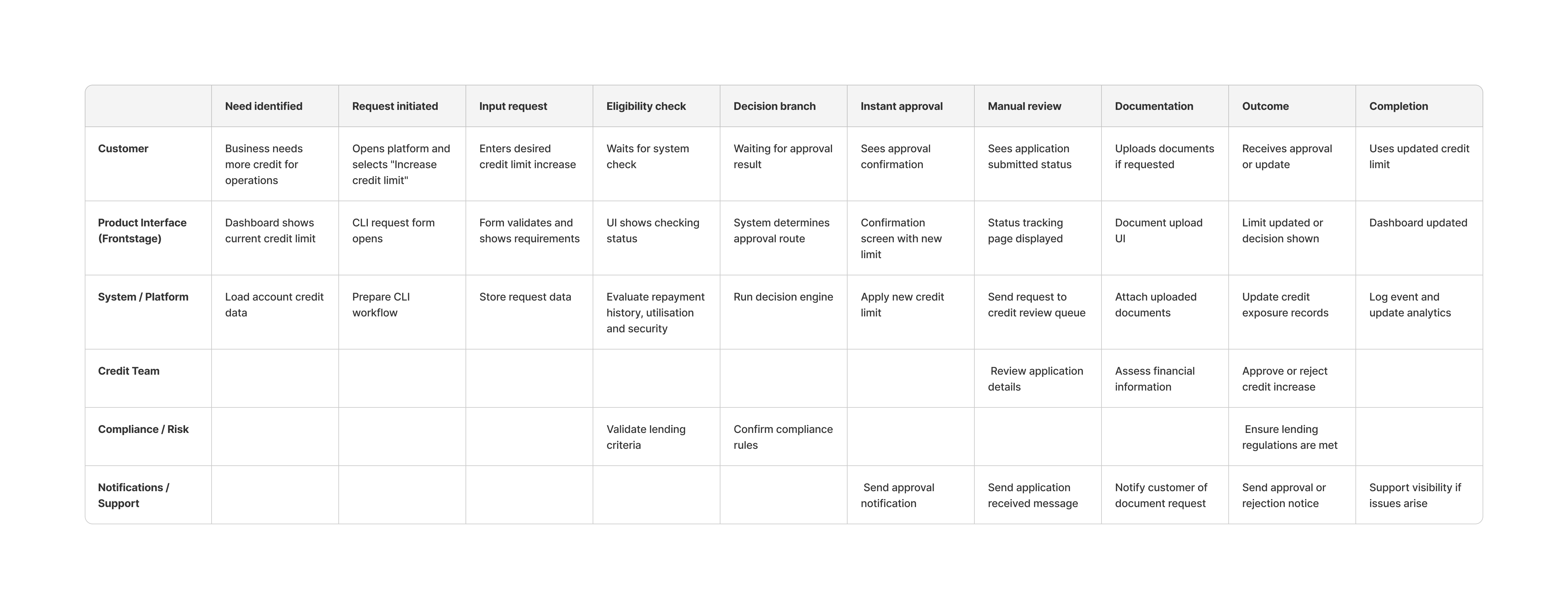
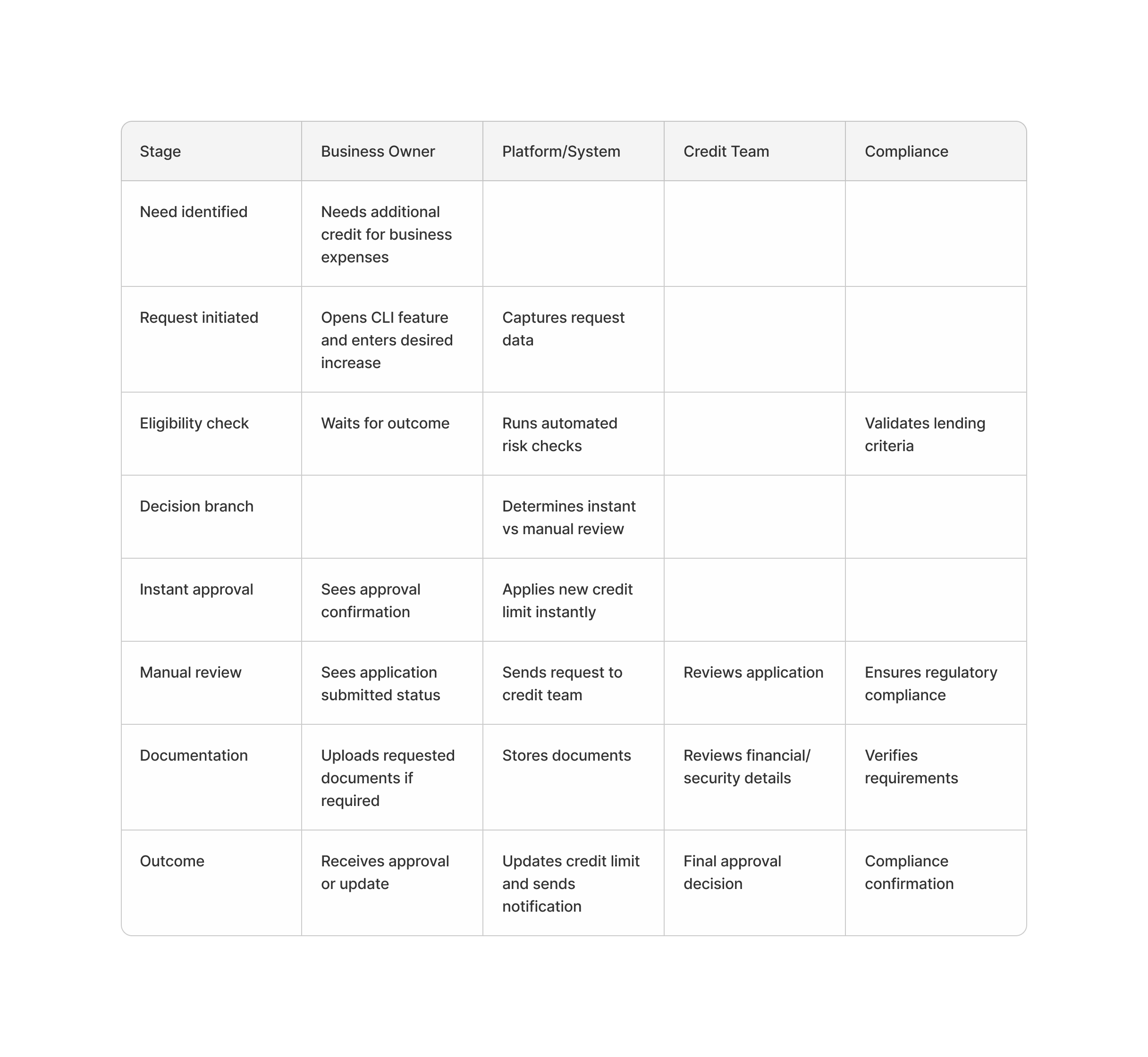
Because there was no existing in-product flow for credit limit increases, I created a journey map to design the feature from the ground up. The goal was to understand how a request would move through the system and where different teams needed visibility or control.
The map was structured across three lanes:
- Customer (business owner)
- Credit team
- Compliance / risk controls
Mapping these perspectives together helped the team understand not just the user experience, but also the internal decision points required to approve credit safely.
The journey covered the full lifecycle of a request:
- Customer identifies the need for more credit and initiates a request within the platform
- System performs eligibility checks based on credit data, repayment history, and security held
- The request branches into two paths:
- Instant approval for businesses meeting predefined credit criteria
- Manual review by the credit team for larger or higher-risk requests
- Compliance and risk checks ensure the request meets lending requirements
- Outcome and notifications update the customer on approval, next steps, or required documentation
By mapping these interactions across teams, the journey made it easier to identify where automation could happen safely and where human review was still required. It also helped ensure the experience remained clear and predictable for customers, while still supporting the credit and compliance teams’ need to manage financial risk.
Design approach
When designing the feature, the main challenge was balancing two competing needs:
- Speed for customers who needed access to more credit quickly
- Risk and compliance requirements from the credit and finance teams
Through discussions with the credit team, it became clear that not every request needed the same level of review. Some businesses already had strong repayment histories and sufficient security in place, meaning their credit limits could safely be increased without manual assessment. Others still required a more traditional review process.
To support both cases, the solution was designed around two clear paths.
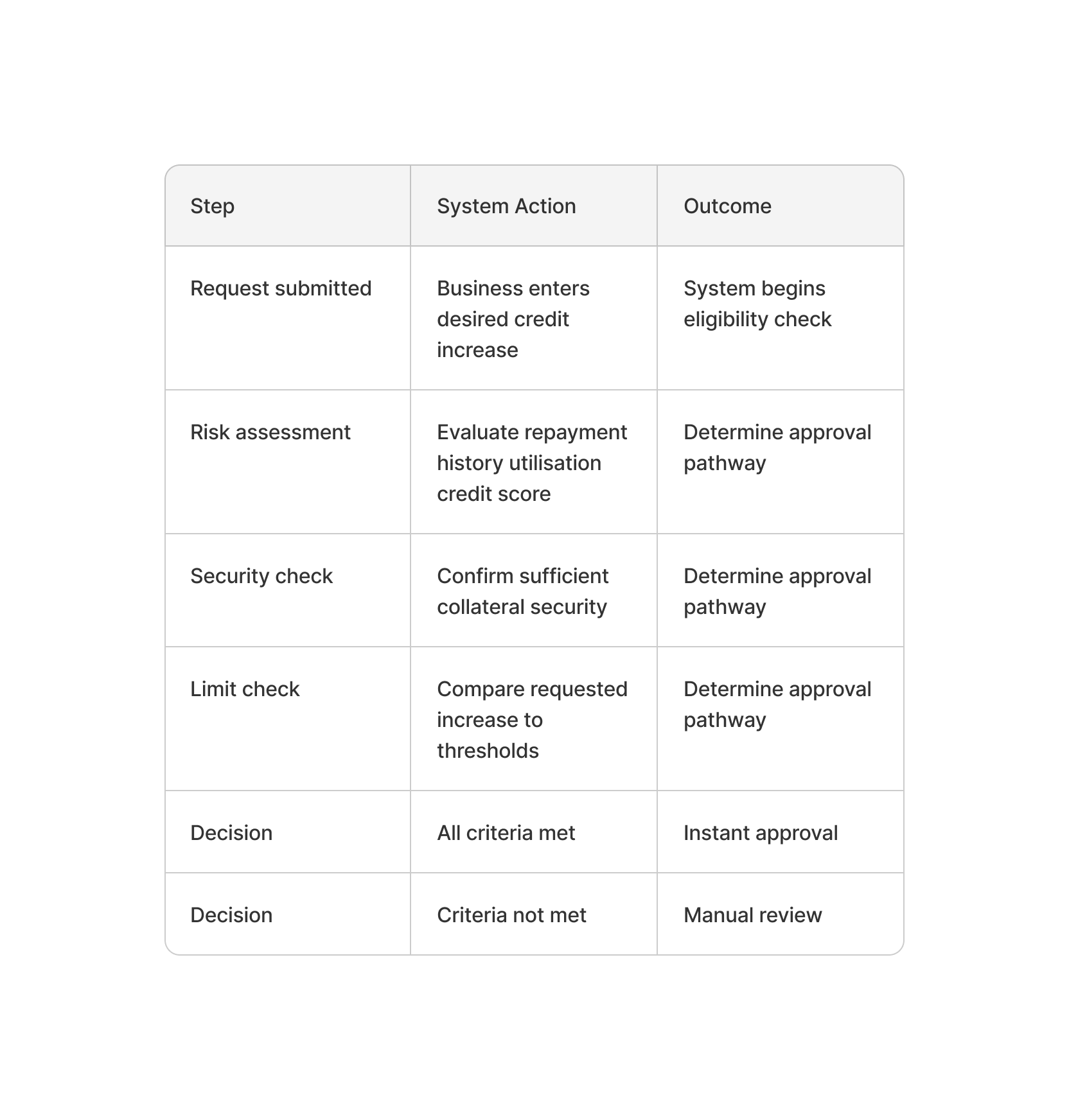
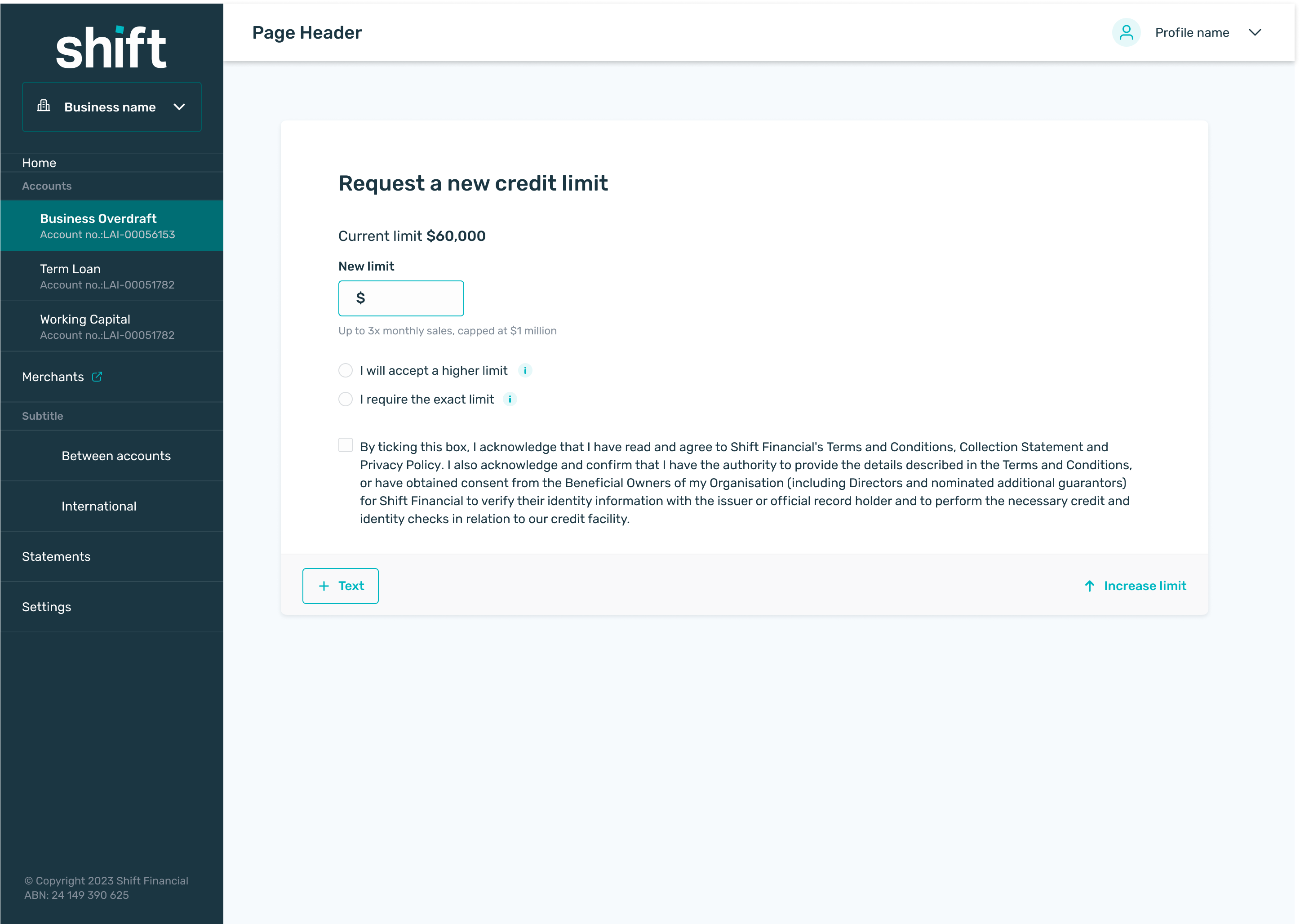
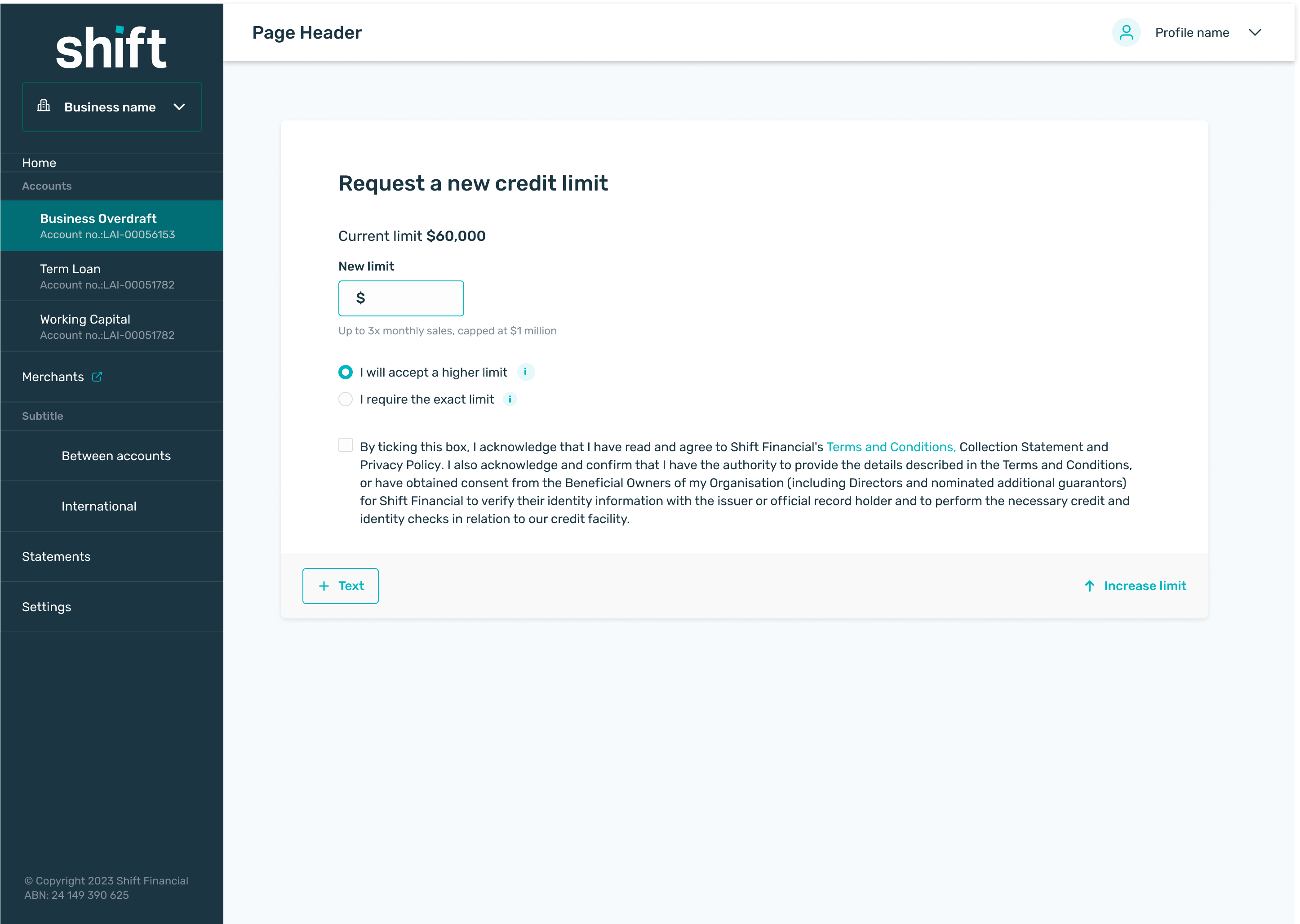
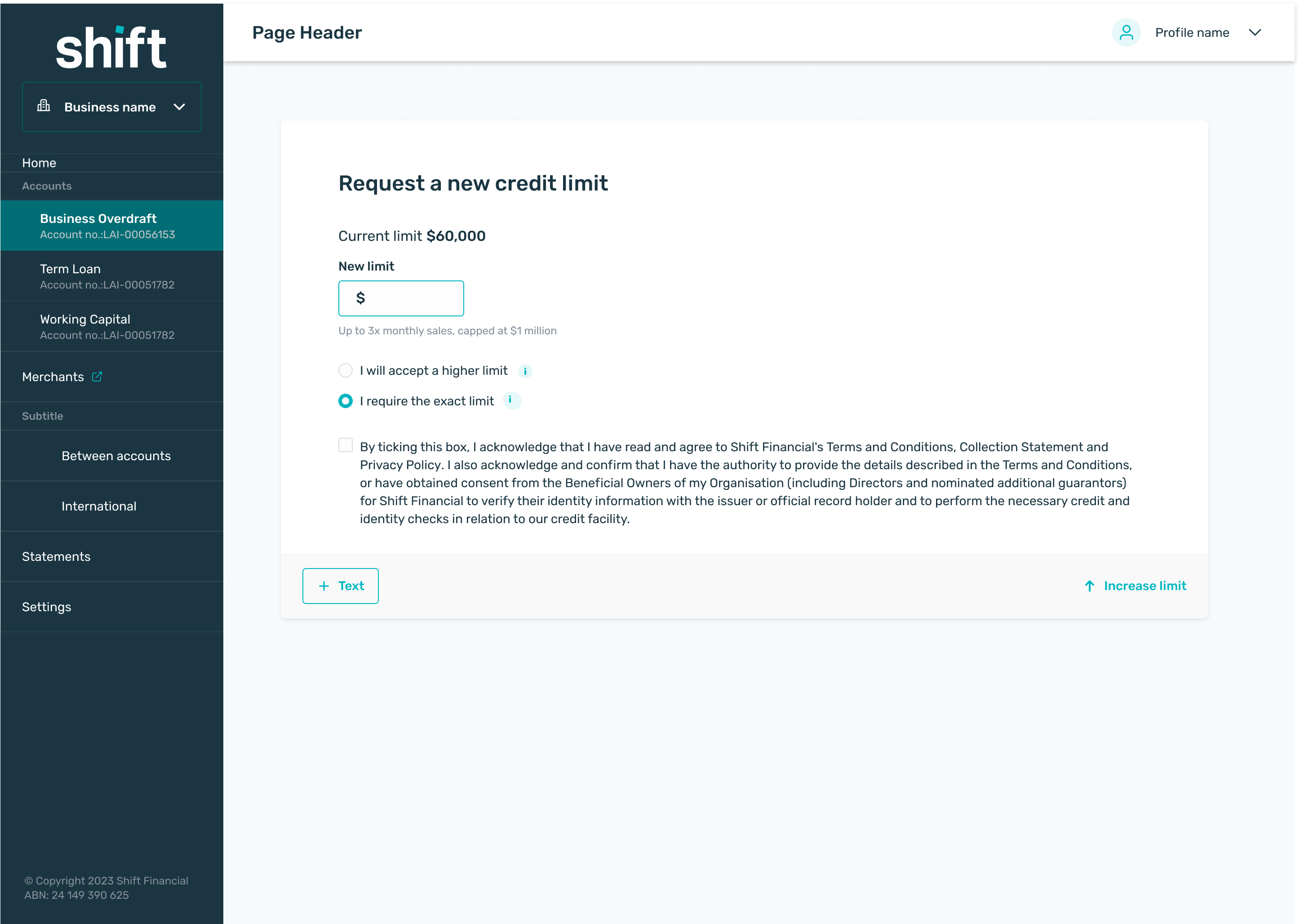
1. Instant approval for eligible businesses
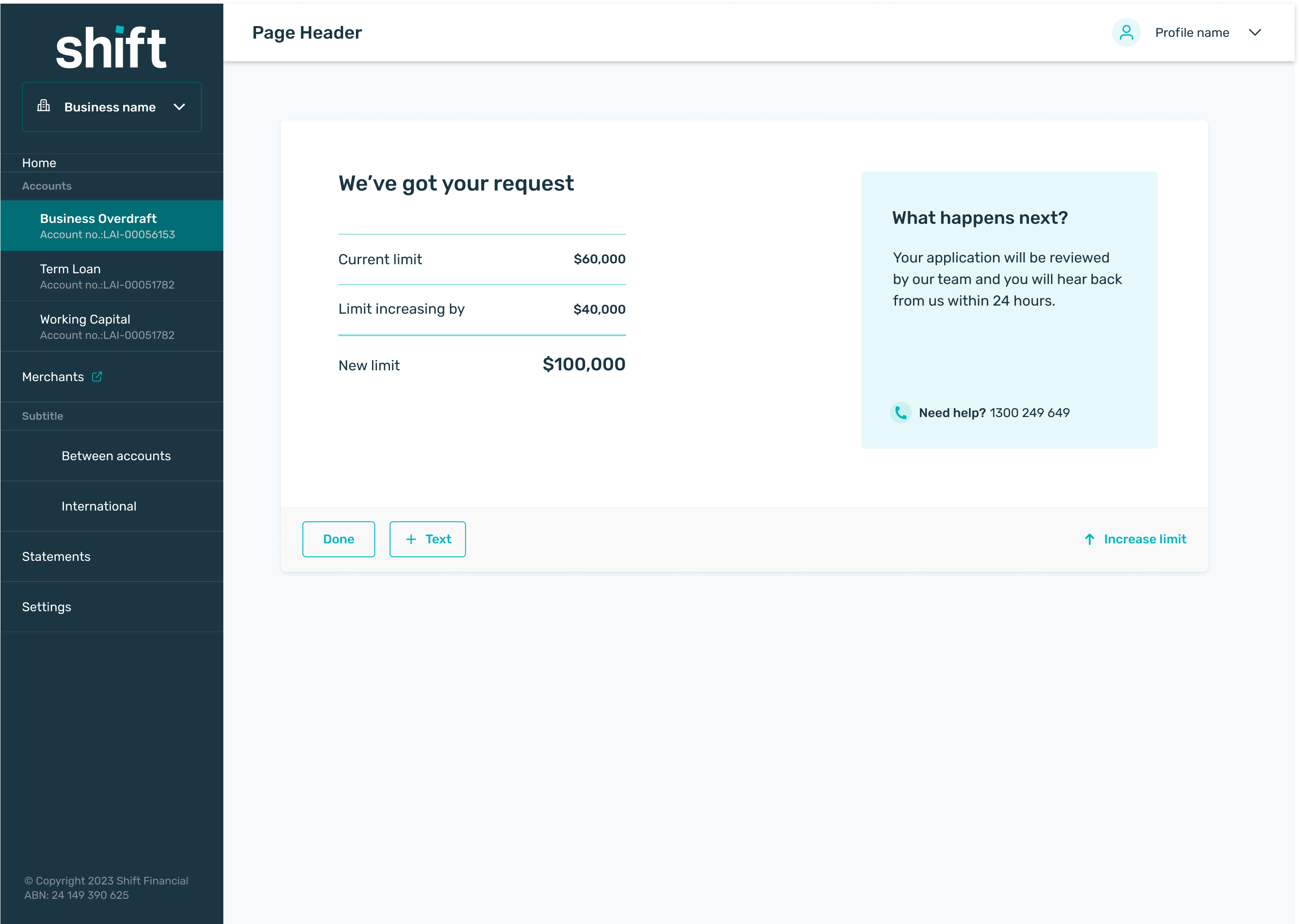
For businesses that met predefined credit criteria, the system could approve a credit limit increase immediately.
These criteria were based on factors such as:
- repayment history
- current credit utilisation
- existing security held by Shift
- internal credit risk scores
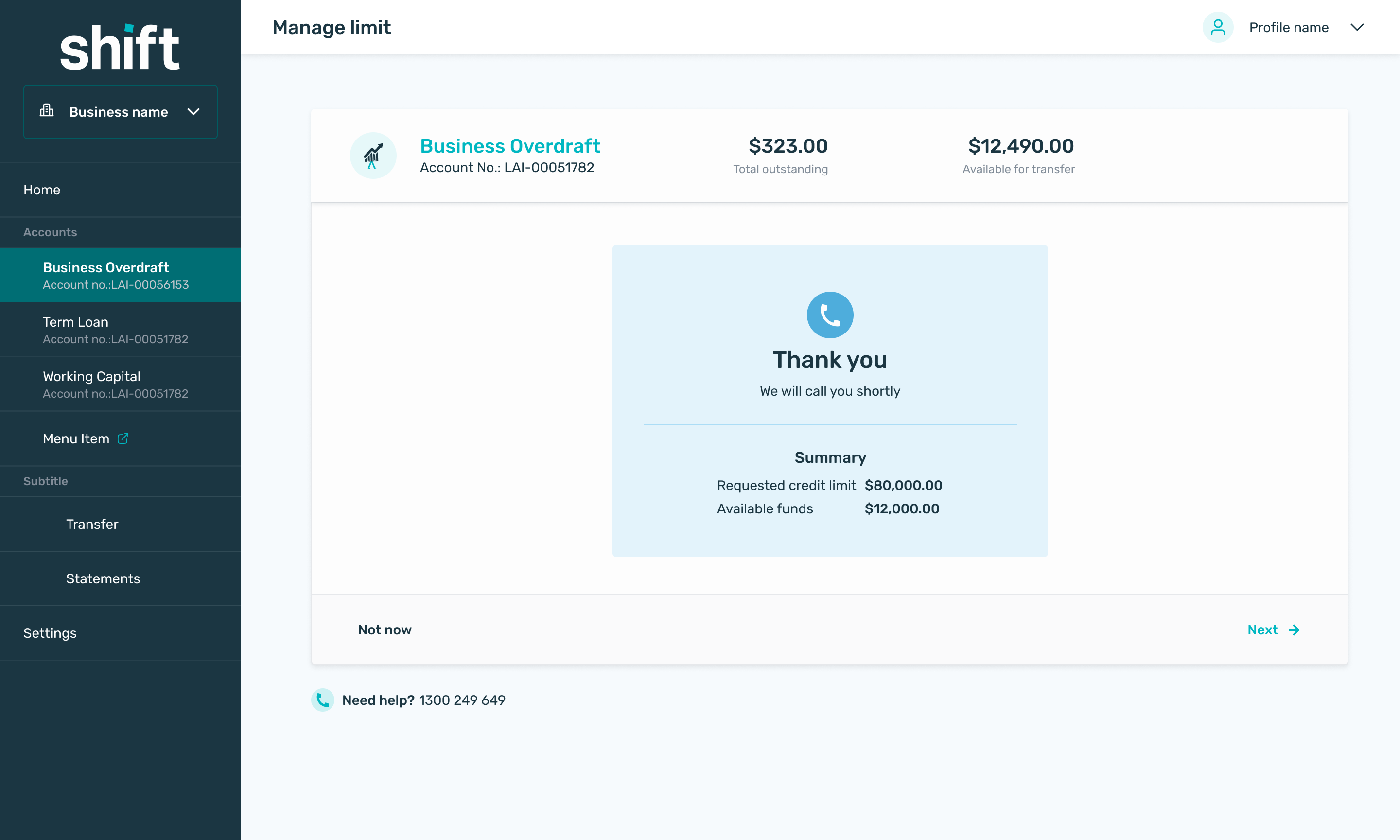
If a business met these requirements, the platform could automatically approve the request and apply the new credit limit straight away. This gave trusted customers fast access to additional capital without needing to contact support or wait for manual approval.
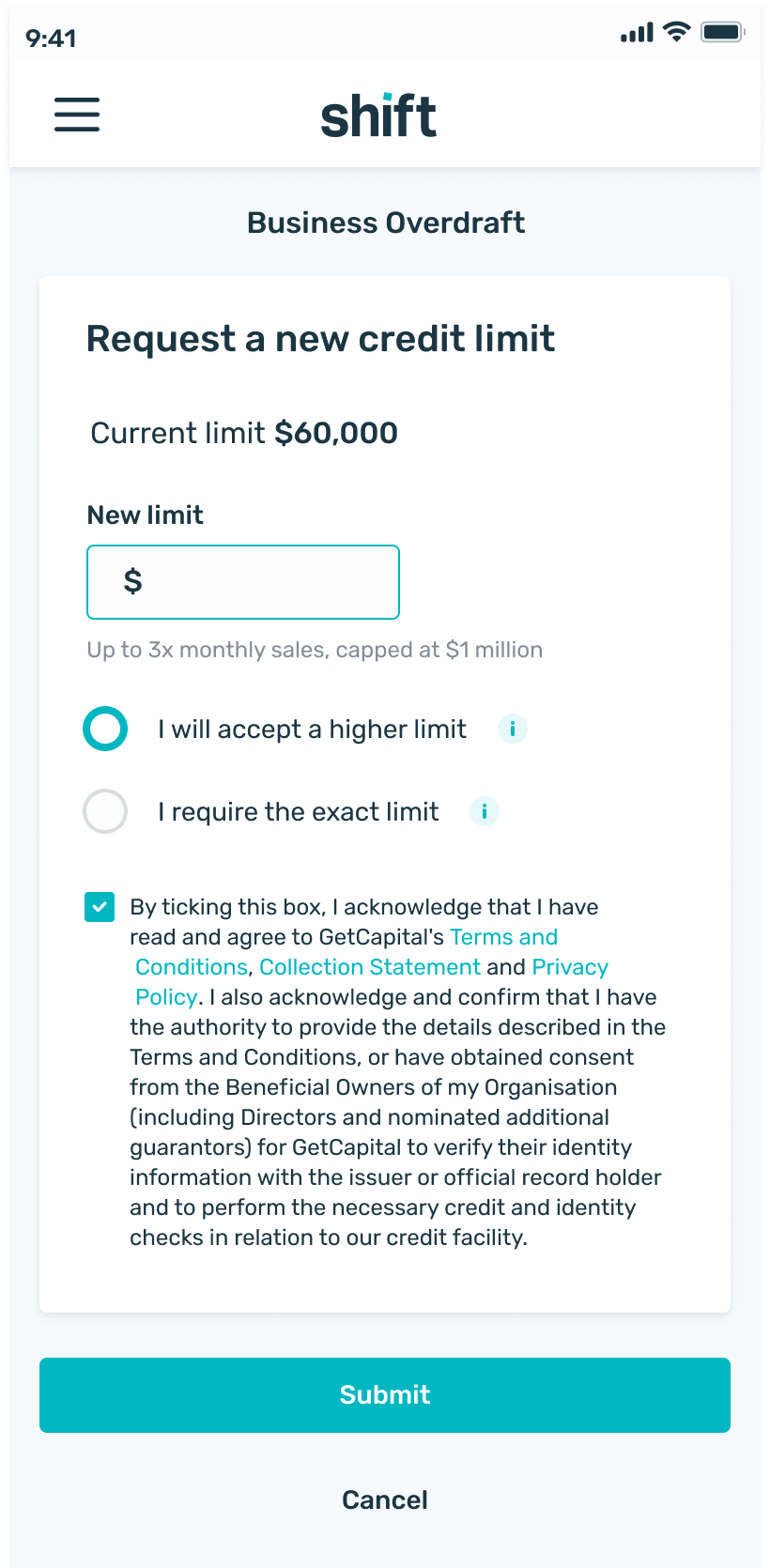
From a user perspective, the process was simple:
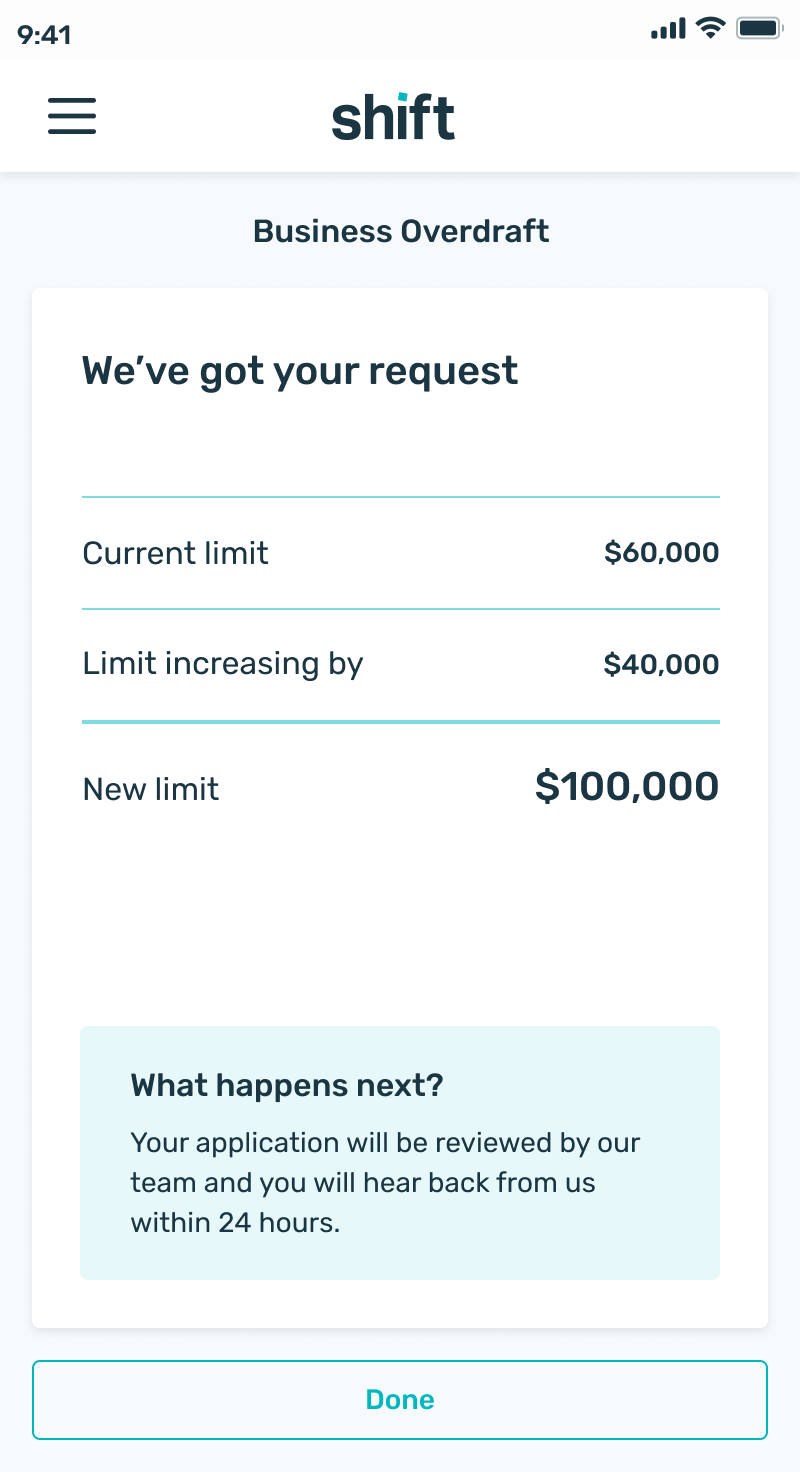
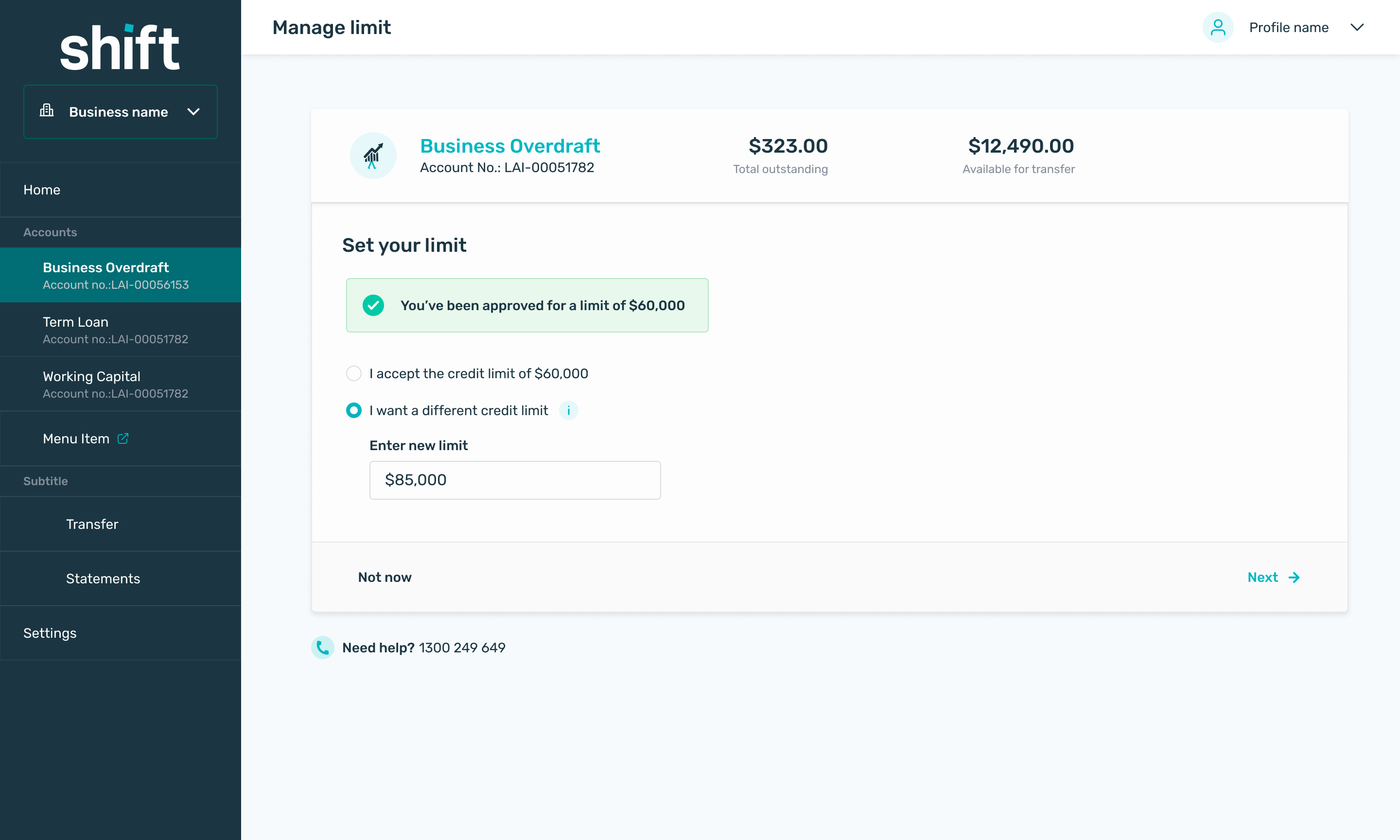
- Enter the desired credit increase
- Confirm the request
- Receive immediate approval and see the updated credit limit in their account
This path removed friction for a large portion of customers and helped the business deploy credit faster.
2. Transparent application tracking for manual approvals
Not every request could be approved automatically. Larger increases or businesses with more complex financial profiles still required review from the credit team. For these cases, the focus was on transparency and clarity.
Instead of submitting a request and waiting with no feedback, businesses could now see:
- confirmation that their request had been submitted
- the current status of their application
- estimated timelines for review
- requests for additional documents or information
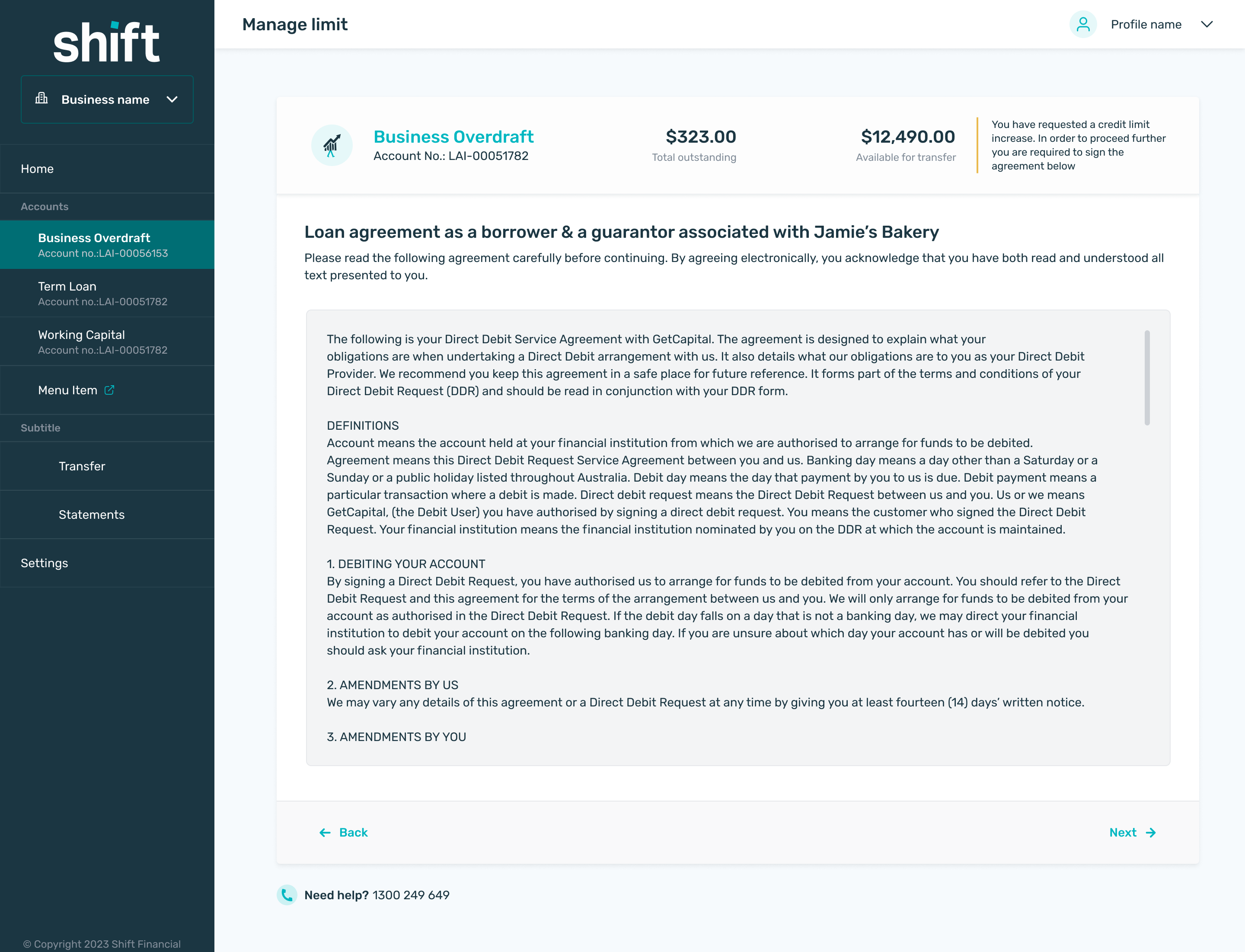
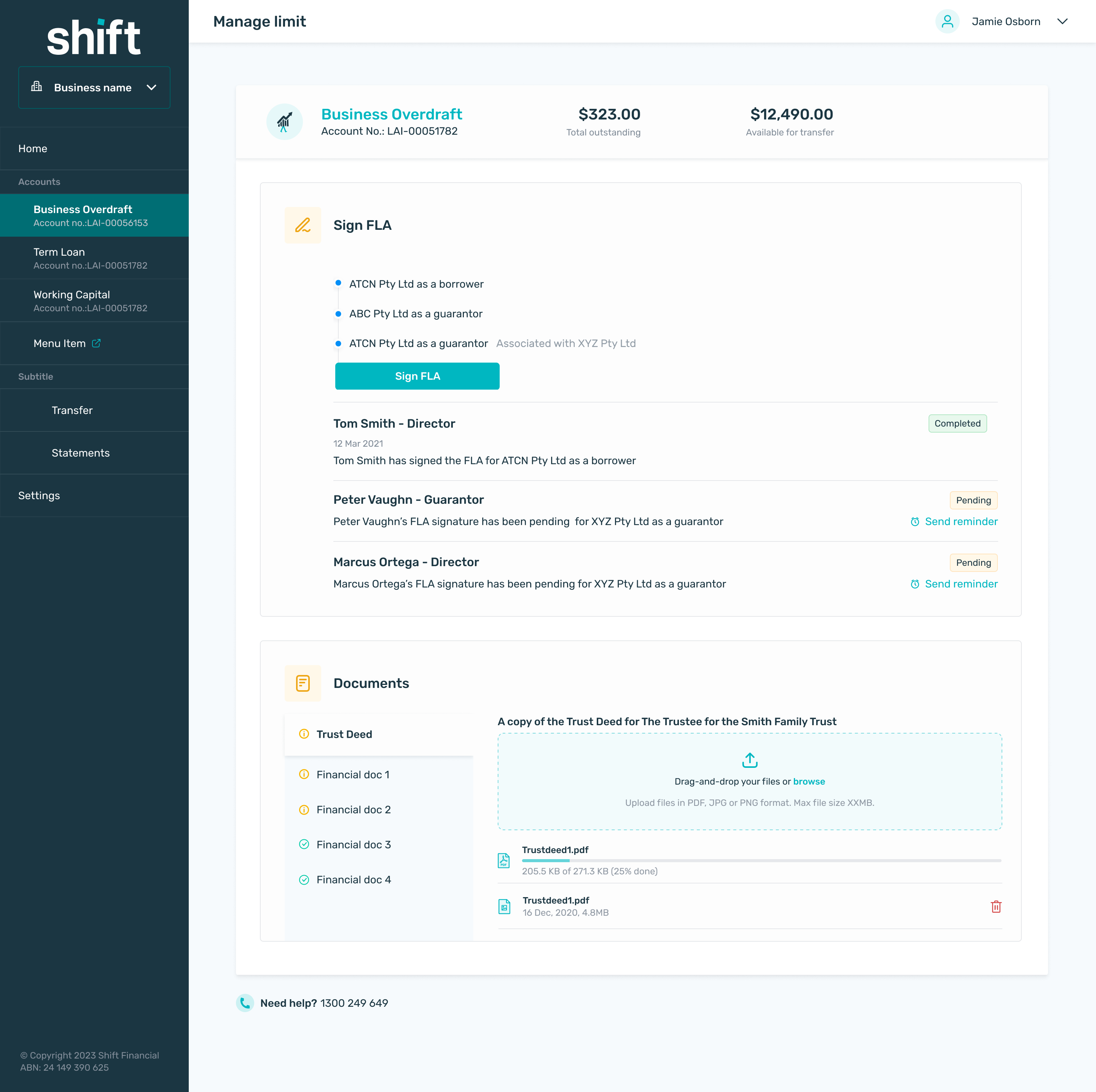
The design also included simple ways for users to upload required documents or provide extra details, reducing the back-and-forth that previously happened over phone and email.
This ensured that even when manual review was required, customers knew what was happening and what to expect next.
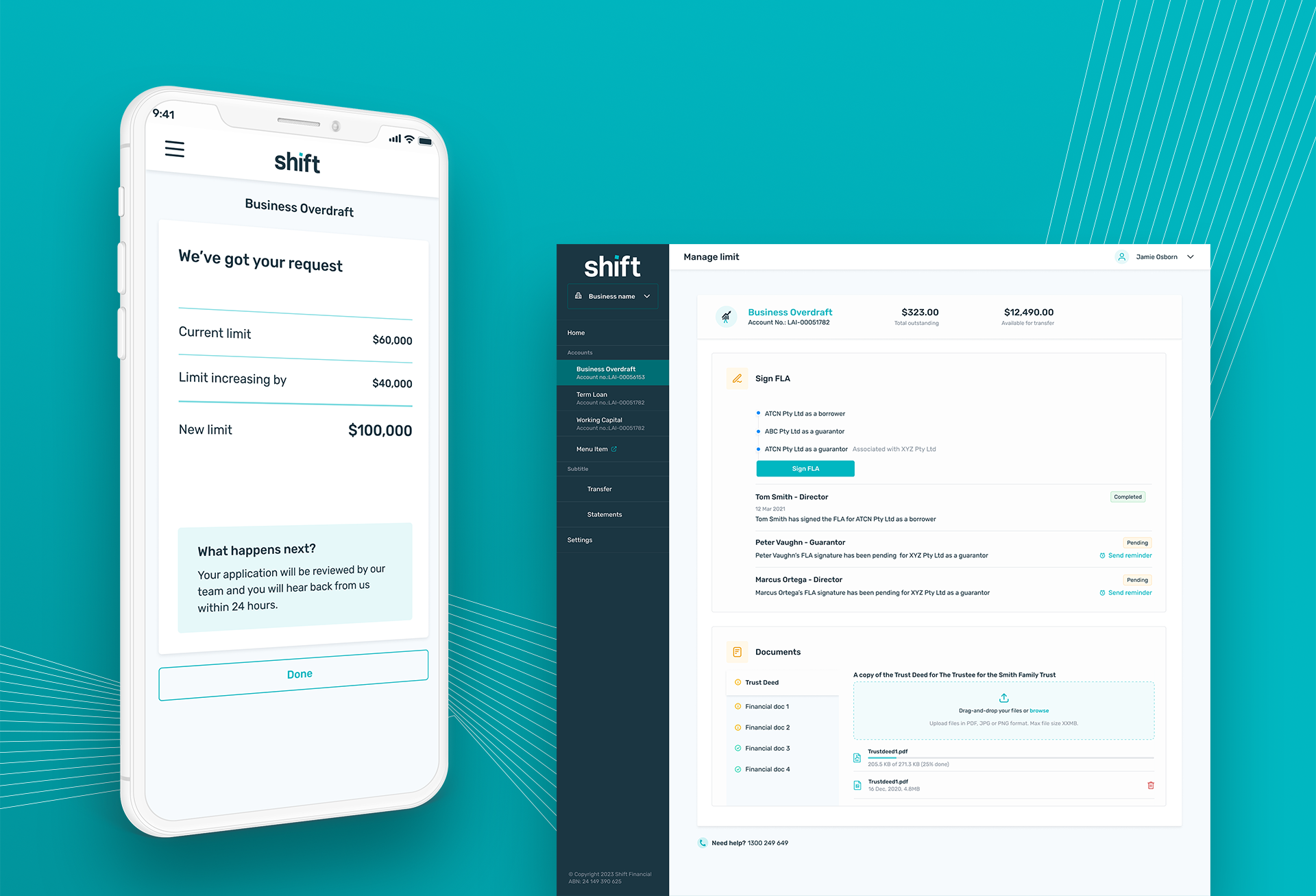
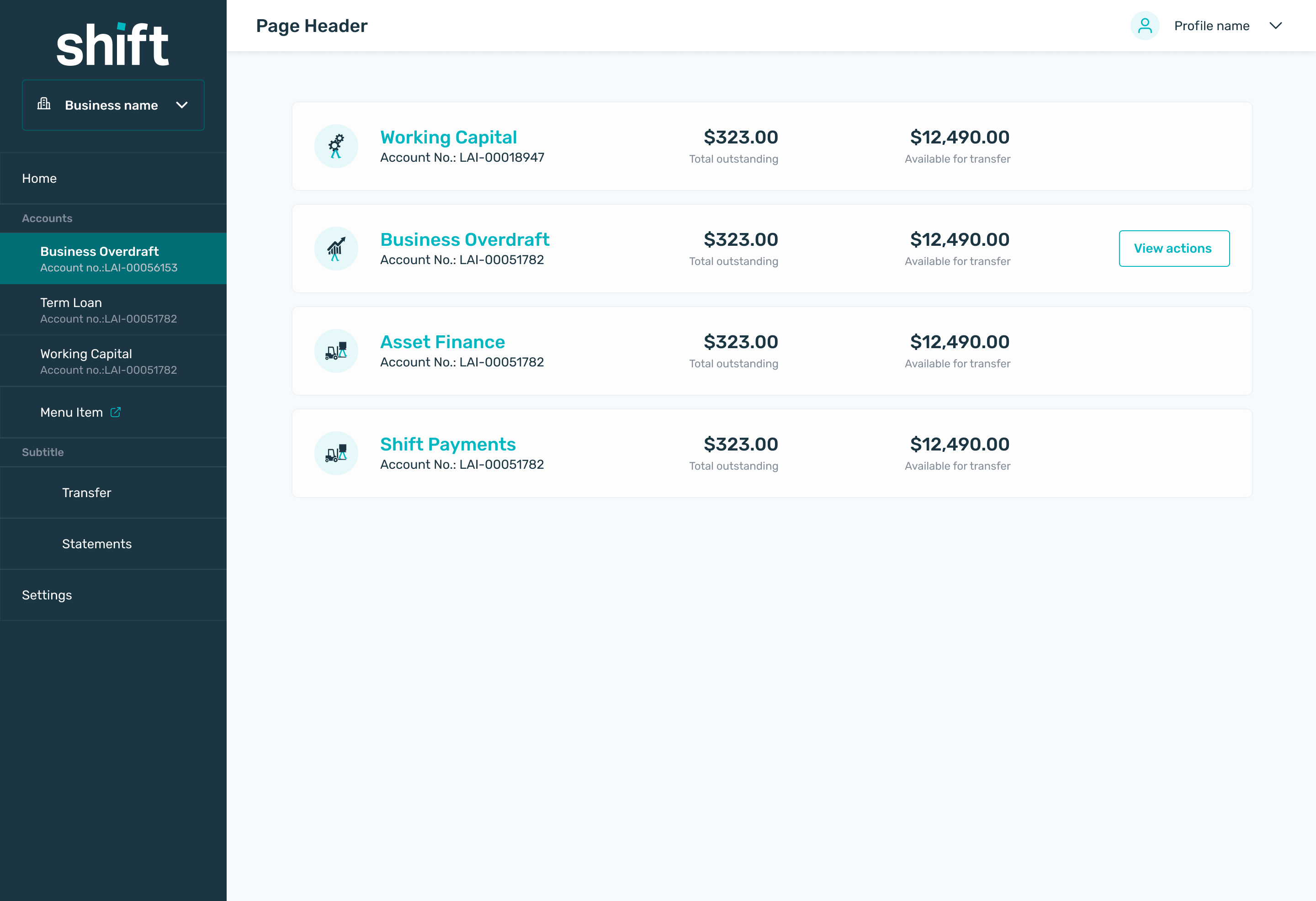
Desktop (auto-approval)
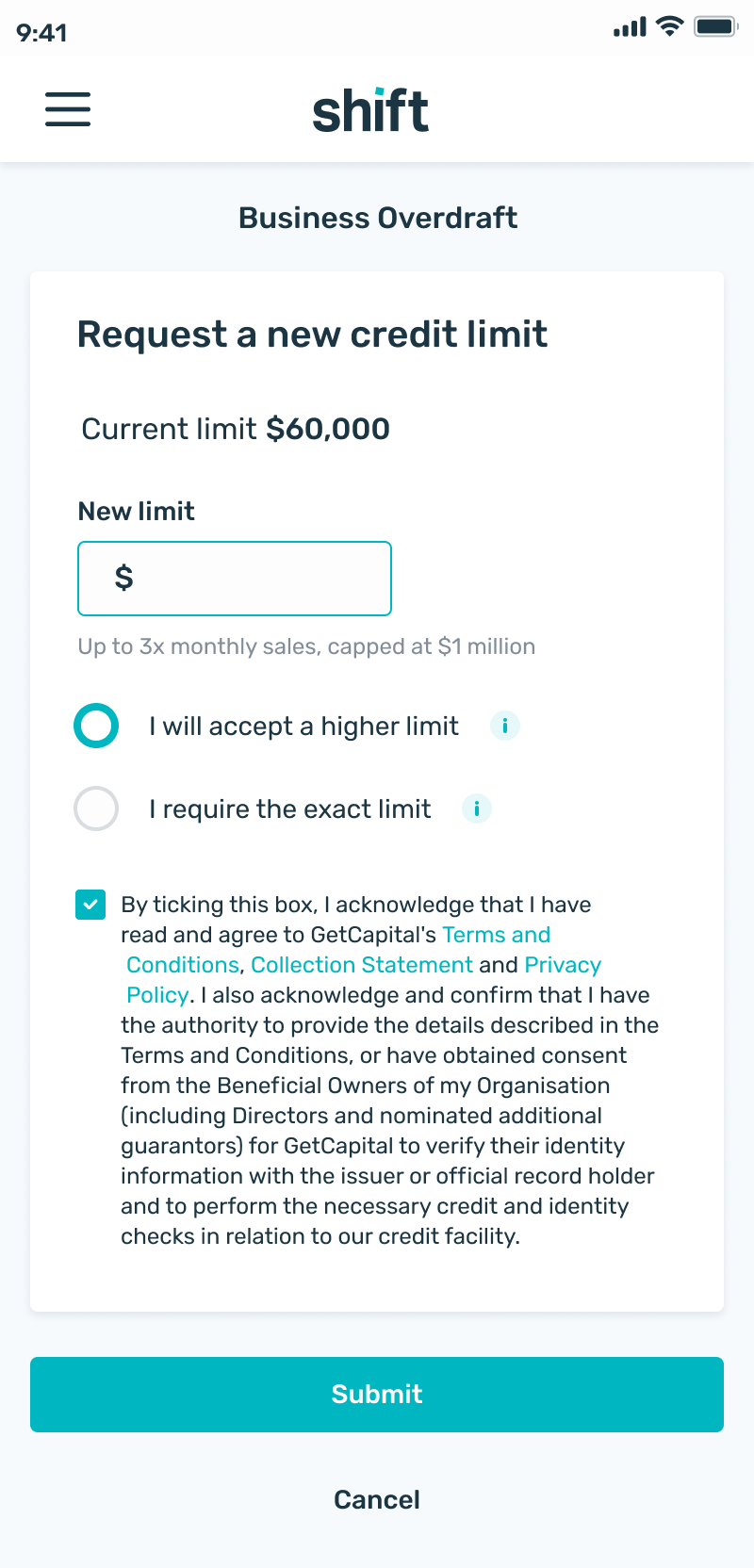
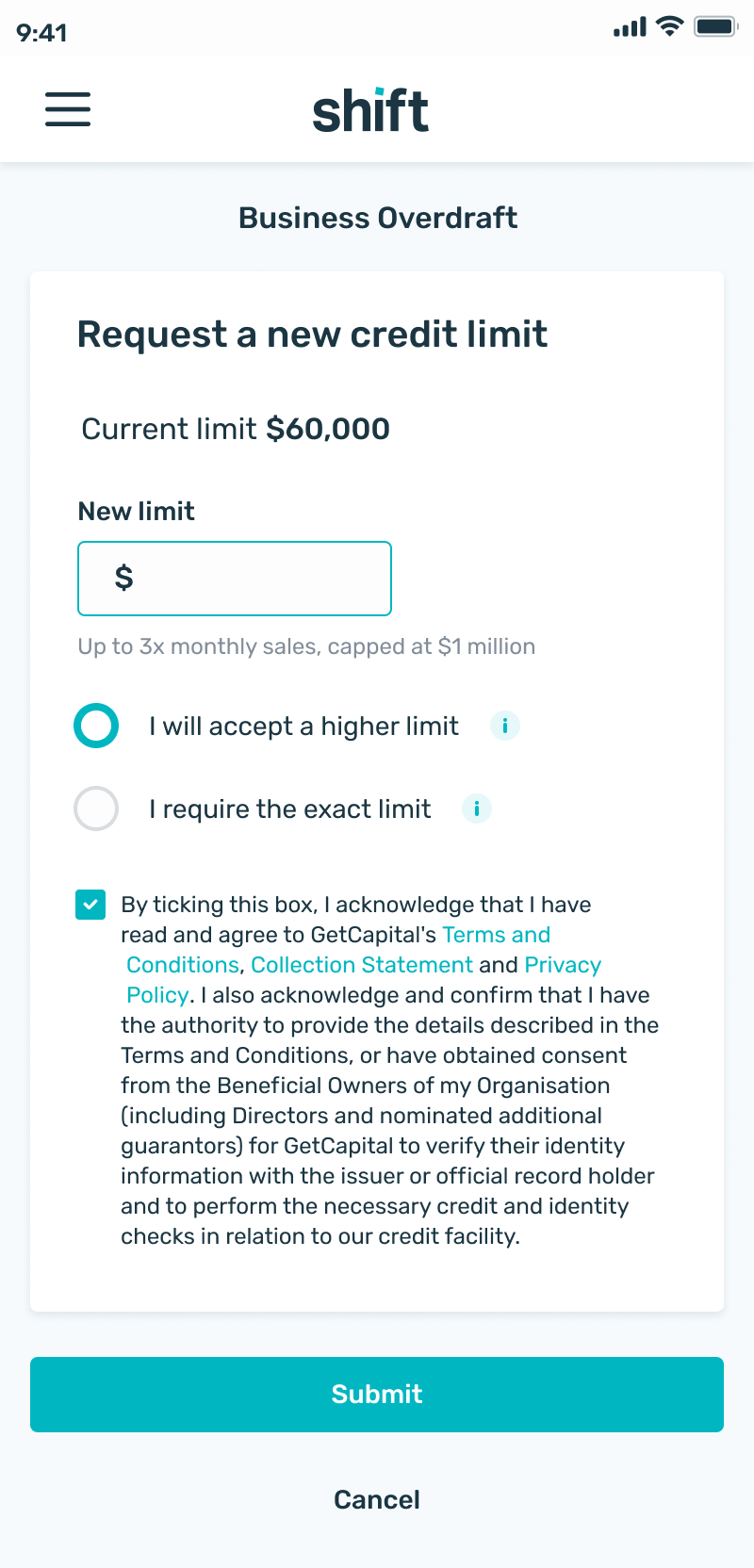
Mobile (auto-approval)
Desktop (manual-approval)
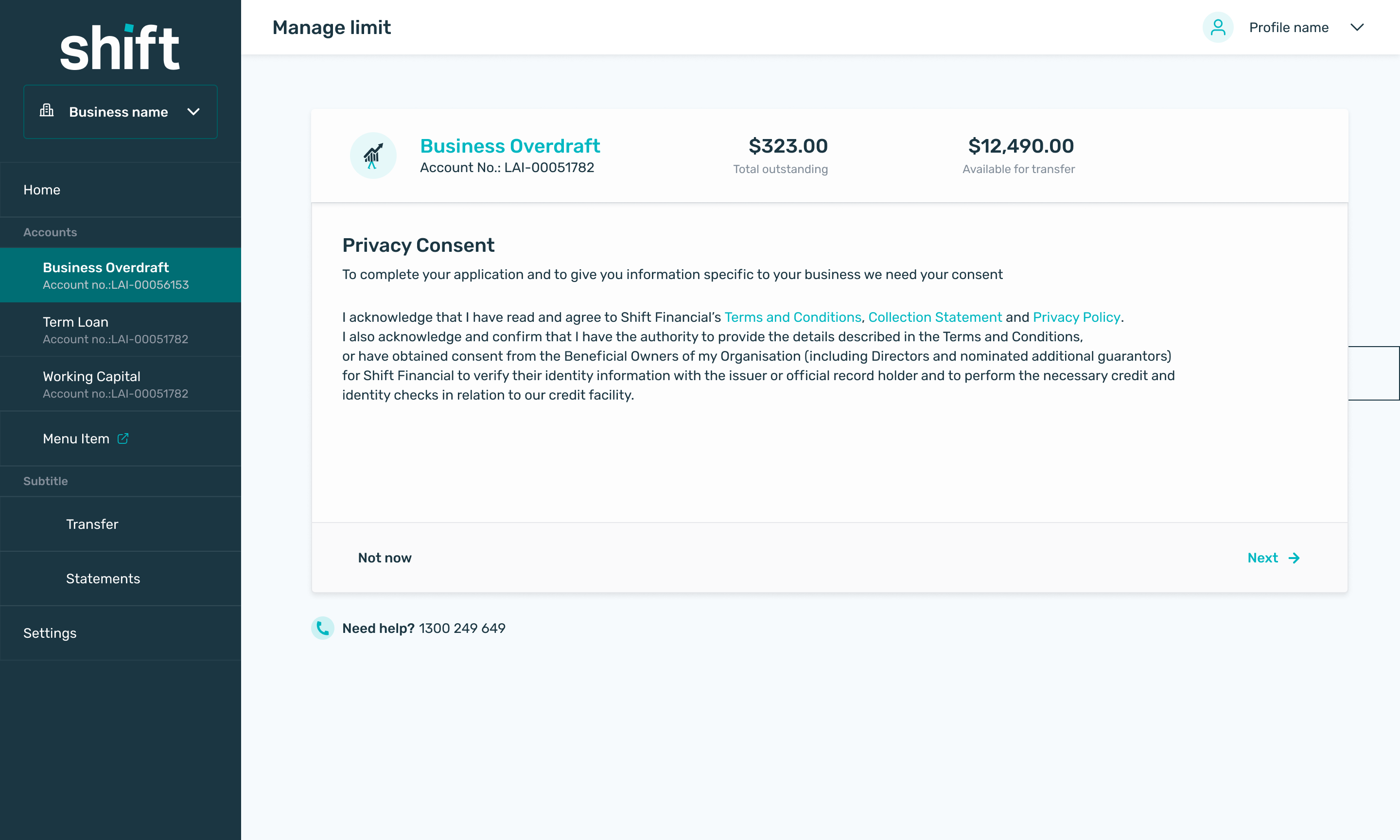
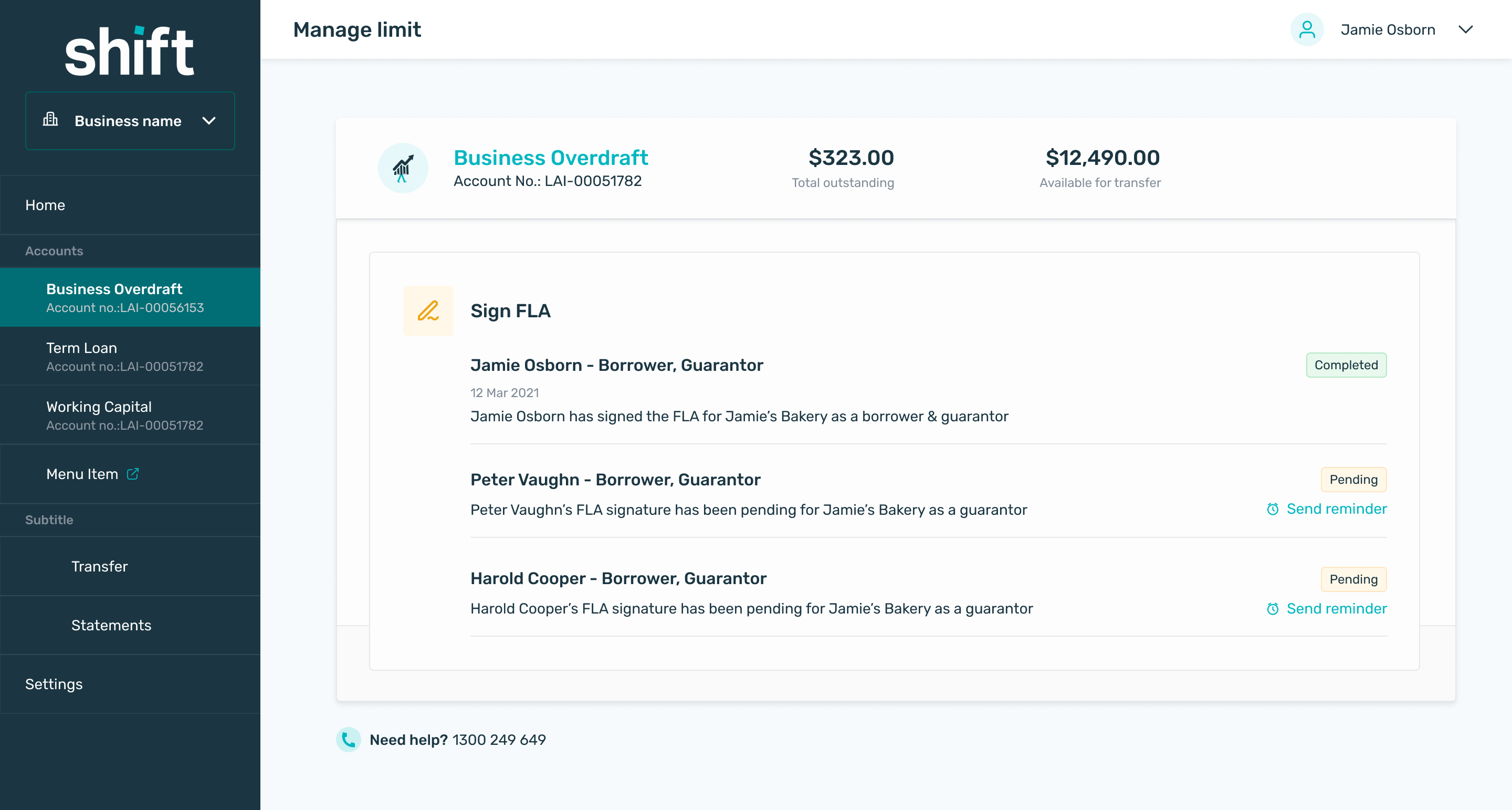
Manual dashboard
Dashboard to manage credit limit increase process for customers whop don't meet pre-approval requirements
Collaboration
This project required close collaboration across multiple teams.
Credit and risk teams
- Defined approval requirements
- Helped identify criteria for instant approvals
Engineering
- Built the automated approval logic
- Implemented system states and notifications
Compliance
- Ensured the experience met financial regulations
- Reviewed data collection and decisioning rules
Working cross-functionally ensured the solution was both compliant and scalable.
Result
The CLI feature delivered measurable business impact.
Within the first 3 months:
- $2M increase in business credit issued
- Reduced support calls related to credit increases
- Faster access to capital for customers
The feature successfully shifted a manual process into a scalable self-serve experience, enabling Shift to deploy capital more efficiently.
Key learnings
Automation requires cross-team trust
Designing financial automation required deep collaboration with credit and compliance teams to ensure risk was managed appropriately.
Transparency builds confidence
Providing application status and clear timelines helped maintain trust even when approvals required manual review.
Self-serve unlocks business growth
By removing friction from the credit increase process, the platform enabled customers to access capital faster while helping the business scale.
Selected Projects

AmaysimMobile app

ABC iViewMobile app

Shift: Credit Limit IncreaseFeature design

NickelcloudSaaS platform (start-up)

Shift: Edit InstalmentsPlatform redesign


P&O CruisesCruise booking website

All of UsMobile app (start-up)



Trade Finance AppStandard Chartered

Advice IntelligenceSaaS platform (start-up)
